

Hiking trails / Paths
What really awaits you on Crete's roads
What this page is about
Crete is a paradise for anyone who enjoys walking, from leisurely paths through olive groves to spectacular gorge trails and mountain tours. At the same time, hiking in Crete is not always as easy as it looks in pictures. Many trails are poorly marked, the terrain can be challenging, and weather conditions play a major role.
On this page, we provide you with factual, practical guidance on what to expect on the trails and paths and how you can better assess hikes.
A few thoughts from practice
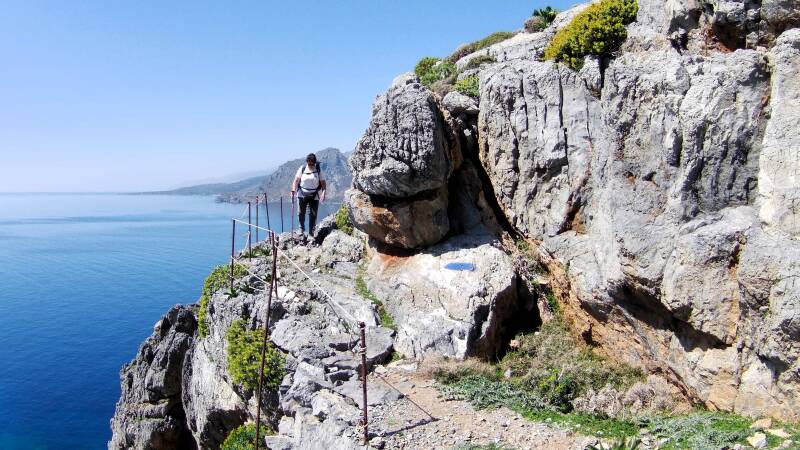
There are hardly any beautifully developed hiking trails and paths as we are used to. Here, you often have to walk over rough and rocky terrain.
There are obvious hiking trails, but also goat paths, streams and cross-country paths that can be used for hiking. It is also permitted to open goat gates (fences) and use the passageway. Of course, it is assumed that every gate that is opened will be closed again!
As we have designed and hiked all our trails ourselves, we can assure you that we have either set markers or that these were mostly already in place, making it possible to find your way around most of the time. In addition, we have designed our hikes so that you not only have a route description at your disposal, but can also use the coordinates and an interactive hiking map. This is not usually the case.
Despite all this, you should be aware that due to the geological structure of the island, mobile phone coverage is not available everywhere. That is why you have the option of saving our hikes with detailed descriptions in PDF format.
What hiking trails and paths look like in Crete
Crete offers a wide variety of trails:
- Easy paths along the coast or through Mediterranean meadows
- Gorge trails, which are spectacular but often rocky and narrow
- Mountain trails with elevation gains and steep sections
- Old connecting paths that used to link villages and pastures
Many hikes lead through varied terrain, from rocky ground in gorges such as the Samaria or Agia Irini Gorge to forest paths and mountain trails.
It is important to note that not all trails are equally well marked. Sometimes they can only be identified by posts, stone markers or faded signs, and in remote areas there is little or no signage.

What many people underestimate before a hike
Good preparation: what really helps
Many people initially think about the distance or the view, but the real challenges are often:
- The technical nature of the route, not just its length or altitude
- Heat and sunlight, especially in midsummer
- Little shade or water sources along the way
- Markings that are not always obvious
Therefore, it is important to plan realistically rather than idealistically. Good preparation is important, and that means more than just having an approximate number of kilometres in mind.
A few points to make your hike much more enjoyable and safer:
- Wear sturdy shoes with good grip, as many paths are rocky or uneven.
- Pack enough water and sunscreen, as shade is often scarce.
- Check the GPS map in advance, as the markings are not always clear.
- Check the weather forecast, as heat, wind or thunderstorms can change conditions significantly.
- Don't judge route lengths by kilometres alone; the terrain is more important than numbers.
Examples of typical hiking trails
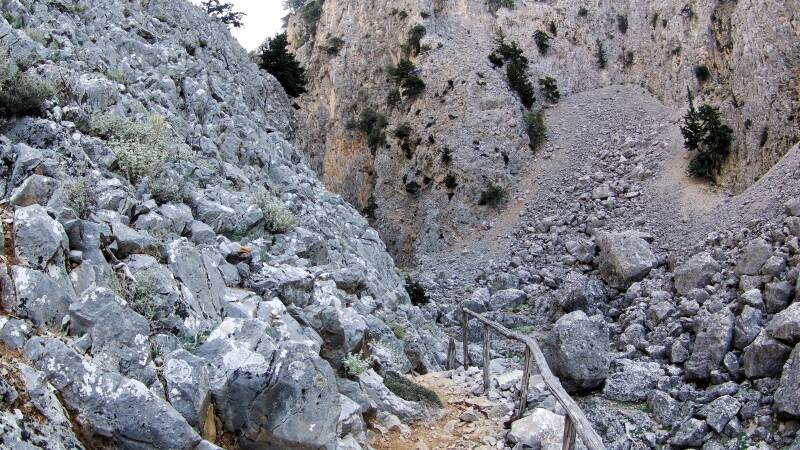
Crete has many rewarding trails, ranging from easy walks to challenging gorges and mountain paths. Here are a few that show how varied the trails can be:
- Samaria Gorge: one of the most famous hiking trails in Europe, quite long and often crowded (classic day hike).
- Imbros Gorge: slightly shorter and easier than Samaria, but still impressive.
- Knossos Gorge: varied and with lots of vegetation, especially beautiful in spring.
- Myli Gorge: pleasant for families, with old watermills and history along the way.
- Mount Juchtas: combines nature, ancient ruins and sea views.
These are just a few examples; there are many hikes on Crete, ranging from easy circular routes to challenging mountain hikes.
Safety and personal responsibility when travelling
Even though many paths are easy to walk on, the following applies:
- Always find out about the route and conditions before setting off on a hike.
No one knows your fitness level or experience. Choose tours that suit you. - Mobile phone reception is often patchy, especially in gorges and mountains.
- Some sections may be steep, slippery or exposed.
- In summer, be sure to start early to avoid the heat.

Conclusion: Hiking in Crete is diverse – plan realistically
The trails and paths on Crete are as varied as the landscape itself. They offer breathtaking nature experiences, but also challenges that should not be underestimated. Well prepared, with the right equipment and a healthy respect for nature, hiking on Crete will be one of the most beautiful experiences of your holiday.
The most important thing is to realistically assess your expectations of the route, difficulty and conditions, then every hike will make you happy, not tired.